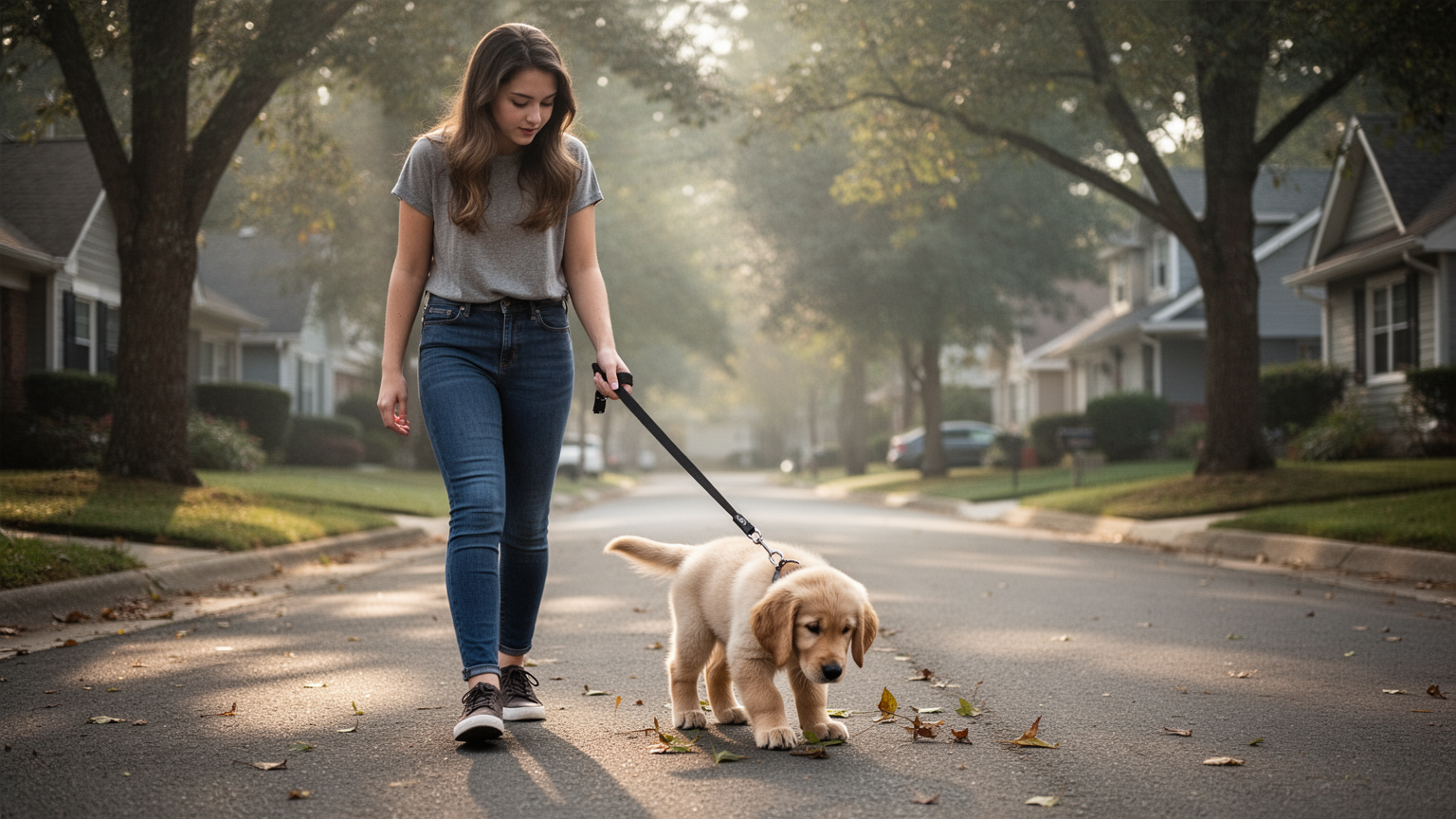
How Often Should You Walk Your Puppy Each Day?
The answer depends on your puppy's age, but a simple starting point is the "five-minute rule": puppies need roughly five minutes of exercise per month of age, twice a day. So a three-month-old puppy needs about 15 minutes of walking, twice daily. The real reason isn't just about burning energy-it's about protecting your puppy's developing bones while building healthy habits that last a lifetime.
If that feels daunting, take a breath. You don't need to be perfect. Most puppies are forgiving, and you'll learn what works for yours pretty quickly.
Why Walking Matters for Puppies
Walking does three important things for your puppy at once.
First, it's exercise. Puppies have energy that needs somewhere to go, and a tired puppy is generally a calmer, better-behaved puppy. That said, puppies aren't little adults-they can't exercise the way grown dogs can, and pushing them too hard can actually cause problems.
Second, walking is how puppies learn about the world. They meet different surfaces, sounds, people, and other dogs. This is called socialization, and it shapes how confident and relaxed your puppy becomes as they grow.
Third, a regular walking routine teaches your puppy to settle down at home. When they know they'll get walking time, they're less likely to spend all day trying to entertain themselves by shredding furniture or jumping on you.
The tricky part: puppies' bones are still soft and developing. Their growth plates-the cartilage at the ends of bones-don't fully harden until they're around 12-18 months old (depending on breed and size). Jumping, running on hard ground, or too much repetitive exercise can injure these plates before they've solidified, potentially causing lasting problems. This is why you can't just take your eight-week-old puppy on five-mile hikes.
Walking Guidelines by Age
8 weeks to 3-4 months old
At this stage, short, frequent walks are best. Two to three short walks per day (10-15 minutes each) are plenty. These don't need to be vigorous. A slow, exploratory wander around the neighborhood is ideal. Your puppy's main job right now is learning to walk on a leash without pulling and getting used to being outside.
4 to 6 months old
You can gradually increase to two 20-30 minute walks per day, or three shorter ones. Your puppy has a bit more stamina now, but they're still growing quickly. Avoid long-distance walks and jumping-save games like fetch for very short bursts on soft ground.
6 to 12 months old
By now, most puppies can handle longer walks: two 30-45 minute walks daily work well for many breeds. Some puppies are ready for light jogging or hiking on soft surfaces (like trails with grass or dirt) in short intervals. However, don't overdo it. A six-month-old Golden Retriever might look full-grown, but their growth plates are still developing.
12 months and older
Once your puppy reaches full skeletal maturity (which varies by breed-ask your veterinarian when this applies to yours), you can move into an adult exercise routine. Larger breeds mature later than smaller ones, so don't rush this transition.
These are guidelines, not laws. Your puppy might need less or more depending on what you see.
Factors That Affect Walking Frequency
Walking needs aren't one-size-fits-all. A few things matter:
Breed and size. A Border Collie puppy will have different energy levels than a Bulldog puppy. Sporting and herding breeds tend to need more exercise. Giant breeds (like Great Danes) can actually be damaged by too much walking because their joints are under extra strain while growing. Smaller breeds sometimes need less. Your puppy's breed isn't the whole story, though-individual personalities vary widely.
Your puppy's personality. Some puppies are naturally calmer and entertained by sniffing. Others are little tornadoes who seem to have endless energy. Watch your actual puppy, not just breed stereotypes.
Weather and heat. On very hot days, cut walks shorter and do them early in the morning or late evening. Puppies overheat more easily than adult dogs, and hot pavement can burn their paws.
Health and development. If your puppy is recovering from illness or injury, or if they're a giant breed with joint concerns, your veterinarian may recommend less walking. Always mention your puppy's exercise plan at check-ups.
Your lifestyle and schedule. If you work long hours, two walks plus midday help from a friend or dog walker is realistic. If you're home, three shorter walks might work better. There's no shame in adjusting the plan to your actual life.
Signs Your Puppy Is Getting Enough Exercise
You don't need to overthink this. Watch for these signs:
- Your puppy settles down calmly indoors after walks and doesn't seem frantic or destructive
- They sleep well at night and aren't waking up desperate to play
- They're not limping or favoring a leg (a sign of soreness or injury)
- They seem happy and interested in their surroundings, not exhausted or withdrawn
- Their behavior isn't escalating-they're not jumping more, barking more, or becoming more anxious
If your puppy is bouncing off the walls after walks, they might need more activity or different kinds of activity (mental stimulation counts-training games, puzzle toys, and sniffing games tire puppies out). If they seem consistently sore, lethargic, or injured, cut back and talk to your veterinarian.
Common Walking Mistakes to Avoid
Walking too much, too hard, too soon. This is the biggest one. Your puppy can't tell you when they're in pain, and damage to growth plates doesn't always show up immediately. Err on the side of shorter walks when they're young. You can always add more later.
Doing high-impact exercise before the growth plates close. Long-distance running, jumping, or intense fetch games can injure developing joints. Save this for when your puppy is fully grown.
Using a retractable leash for a young puppy. They don't teach good leash manners, and your puppy can jerk suddenly and hurt their neck. A standard 1.5-2 meter leash gives you control and safety.
Assuming all "play" counts as exercise. Rough play with another dog can be intense but uncontrolled. Structured walks-where you're guiding the pace and the puppy is on a leash-give you much better control over how hard they're working.
Walking on hard surfaces only. Concrete and asphalt are tough on developing joints. Grass, dirt, and softer ground are gentler. Mix surfaces when you can.
Forgetting that a tired puppy is often an anxious puppy. More exercise doesn't fix anxiety, jumping, or mouthing. These are learned behaviors that need training. Exercise alone won't solve behavioral problems.
Building a Walking Routine
Start by deciding how many walks make sense for your schedule. Two is a realistic minimum for most puppies; three is great if you can manage it.
Pick rough times and stick to them. Morning, midday (or midday help), and evening, for example. Puppies thrive on predictability. When they know walks happen at certain times, they're less likely to spend the rest of the day begging.
Keep a simple note of what you notice: Was your puppy pulling hard? Did they seem tired? Did they limp afterward? After a week or two, you'll see patterns. Maybe your puppy needs slightly longer walks, or maybe they're sore the day after certain types of activity. Use this to fine-tune.
Be flexible. Bad weather, illness, a busy week-it happens. One short walk instead of two won't ruin your puppy. The goal is consistency over time, not perfection on any given day.
Start introducing variety once your puppy is walking well on a leash. Different neighborhoods, parks, surfaces, and environments all count as walking and keep things interesting for your puppy's brain.
FAQ
My puppy seems exhausted after just 10 minutes. Should I worry?
Not necessarily. Young puppies tire quickly-their bodies are working hard just to move around and process new information. If they're sleeping well and seem healthy otherwise, short bursts of tiredness are normal. However, if they seem unusually lethargic, reluctant to move, or are limping, mention it to your veterinarian.
Can I take my five-month-old puppy on a longer hike with the family?
Short hikes on soft ground are fine in moderation, but avoid steep terrain, long distances, or hard surfaces like rocky trails. A 45-minute walk on a gentle dirt path is probably okay; a two-hour hike with lots of elevation is too much. Start small and watch how your puppy recovers afterward. If they're sore the next day, you overdid it.
What's the difference between walking and playing, exercise-wise?
Walking is controlled movement on a leash at a steady pace. Playing (like fetch or running with other dogs) is intense, variable, and uncontrolled. Both tire puppies out, but walking is safer for growing joints because you control the intensity. Play is important for puppies too, but it shouldn't be their main form of exercise while young.
My puppy pulls hard on the leash. Does that mean they need more walking?
Not always. Pulling can mean they need more walking, but it usually means they haven't learned leash manners yet. Work on loose-leash walking during your walks-use treats to reward walking close to you without pulling. If your puppy settles at home after walks and doesn't seem frantic, pulling might just be inexperience, not lack of exercise.
How do I know when my puppy is ready for adult exercise routines?
Ask your veterinarian. Giant breeds might not be ready until 18 months; smaller breeds might be ready by 12 months. Your vet knows your puppy's growth timeline and can tell you when it's safe to increase intensity and duration.
References
American Veterinary Medical Association (2023) 'Puppy Care', AVMA. Available at: https://www.avma.org/resources-tools/pet-owners/petcare/puppy-care (Accessed: 15 January 2025).
Zink, M.C., Straus, J.B. and Keating, S.C.J. (2009) 'Assisting Decision-Making on Age of Neutering for Dog Populations: Associated Joint Disorders, Cancers, and Urinary Incontinence', Frontiers in Veterinary Science, 5, p. 388. doi: 10.3389/fvets.2018.00388.